
By Rocky Johnston, Associate Director, Financial Services
Anyone who has spoken to me knows how highly I think about offset accounts. I talk about them constantly, but after the recent Budget announcement, I think they have become more important than ever.
If you have a mortgage on your home and you have funds sitting in a normal savings account, I’ll explain why that money should be sitting in your offset account instead.
An offset account does not pay you interest. It saves you interest at whatever rate applies to your home loan. Crucially, you do not pay tax on that saving. If your mortgage rate is 6%, your offset is effectively saving you 6% after tax.
People sometimes push back and say their bank charges slightly extra for an offset account. Yes, you should check the numbers (particularly if you have a large loan and only a small amount of savings), but if you have built up a decent amount of cash, that small charge should not make or break whether you have an offset account or not.
For example, let’s say you manage to jump through all the hoops your bank may throw at you, and you’re earning their highest savings interest and get 5% annualised rate. If you are paying tax at 39% (including Medicare) you are only keeping around 3% of the 5% interest after tax. If you are in a higher tax bracket, it is even worse. So, we are comparing saving roughly 6% with 3%. Twice as much.
Say you have $100,000. If you put that in your offset account, you will save approximately $6,000 per year. Compare that with putting it in a regular savings account and you’ll see about $3,000 earned in interest after tax. Same $100,000, same access to the money and a more than $3,000 per year difference. I know what I am choosing.
What does this have to do with the Budget?
Under the Budget changes, if you buy an existing residential property after Budget night (Tuesday 12 May 2026) then rent it out and it makes a tax loss, you will no longer be able to use that loss to reduce the tax you pay on your salary or other personal income - this was previously how negative gearing worked.
In simple terms, the Government is restricting negative gearing on these properties. New builds are treated differently, while properties owned before Budget night are generally grandfathered. Grandfathering means the existing negative gearing rules can continue to apply while you retain ownership of the property. Though we are still waiting on final legislation to confirm this applies to primary residences, I’m confident this will be included.
What does this have to do with your offset account?
Your current home may eventually become an investment property. You might upgrade homes in five, 10 or 15 years and decide to keep your current property and rent it out – many do. If you go down that route, the amount of original debt you have preserved against that property could make an enormous difference.
This is where some people accidentally cost themselves a fortune.
Some people make large additional repayments directly into their home loan. Others keep the same money in their offset account. While they are living in the property, the interest outcome can be virtually identical, but the future tax outcome can be completely different.
As an example, let’s compare two couples.
Both couples borrow $2 million to buy their home at age 40.
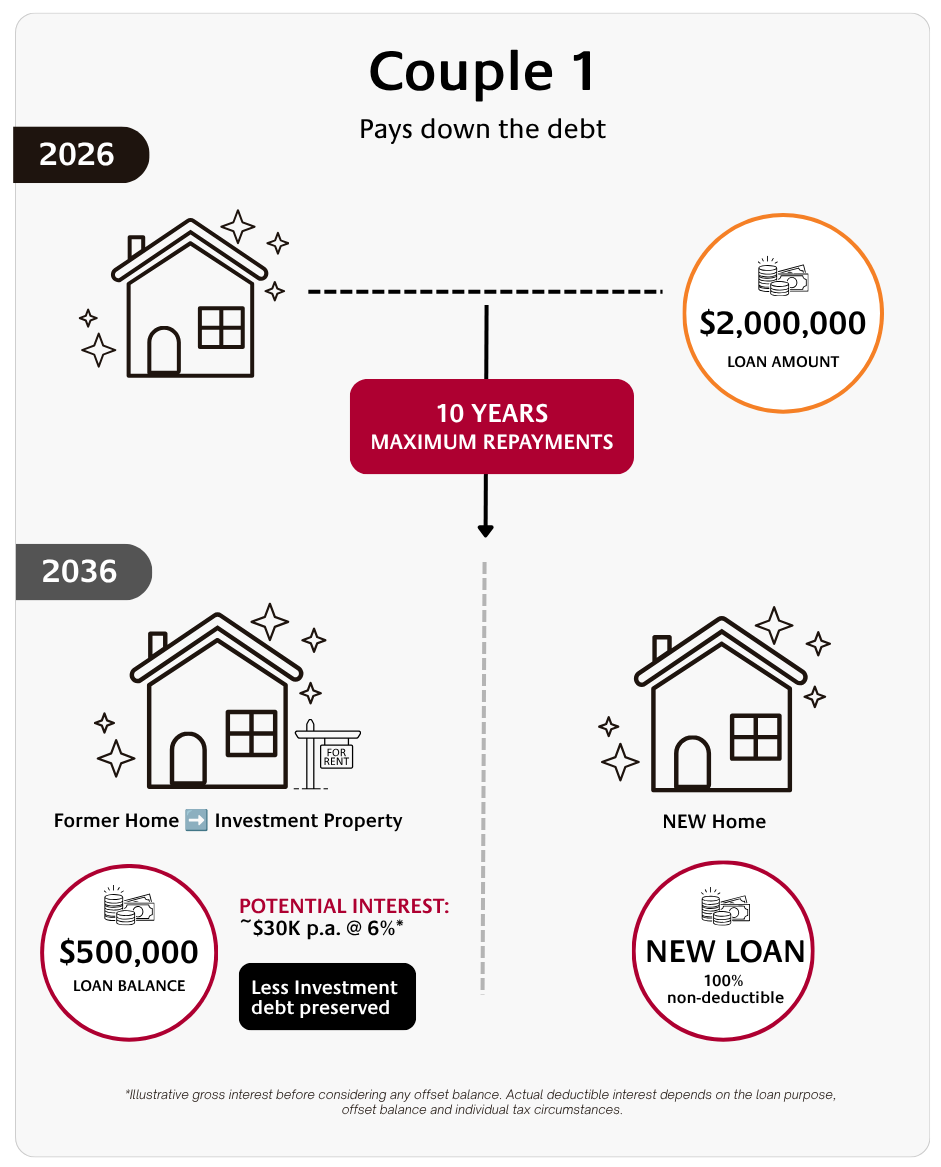
Couple 1 makes large additional repayments directly into the mortgage and reduces the loan balance to $500,000 over the following 10 years.
Couple 2 makes only the required repayments. Their loan balance is still $1.2 million, but they have $700,000 sitting in their offset account.
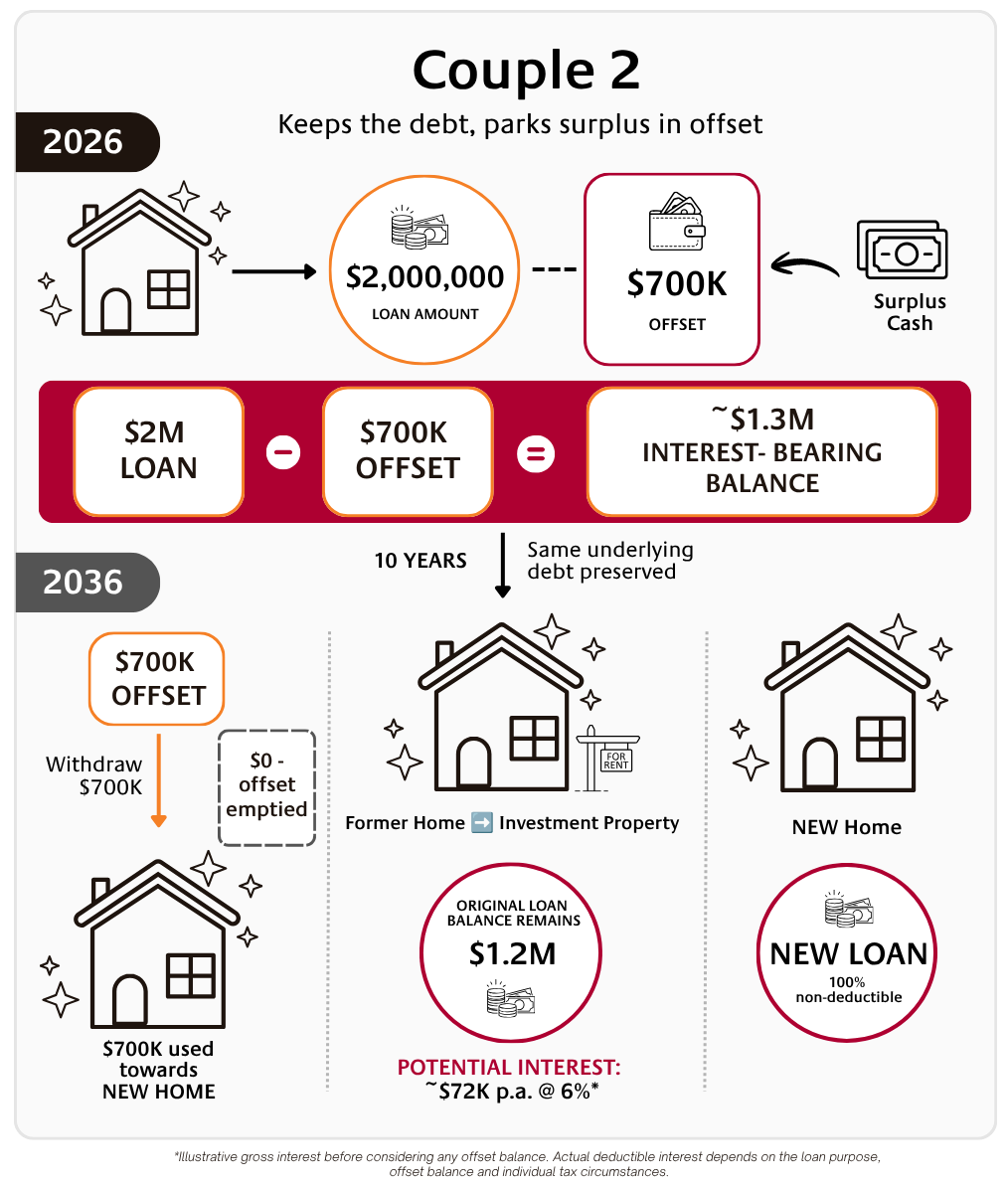
Both couples effectively have net debt of $500,000 and are paying interest on roughly the same amount. Mathematically, they are in almost exactly the same position.
Then, at age 50, both couples decide to upgrade homes and keep their existing home as an investment property.
Couple 1 only has a $500,000 loan remaining against the existing property. They might have a large amount available through redraw, but redraw is not the same as an offset. If they redraw money and use it to buy their new family home, that money has been borrowed for a private purpose. The interest on that amount will generally not become tax deductible simply because the old property is now being rented out.
Couple 2 has a very different outcome. They take their $700,000 of savings out of the offset and put it directly towards their new home. Their original $1.2 million loan remains in place against the old property.
Once the old home becomes an investment property, the interest on that loan may generally become deductible, subject to their circumstances and the property qualifying under the grandfathering rules.
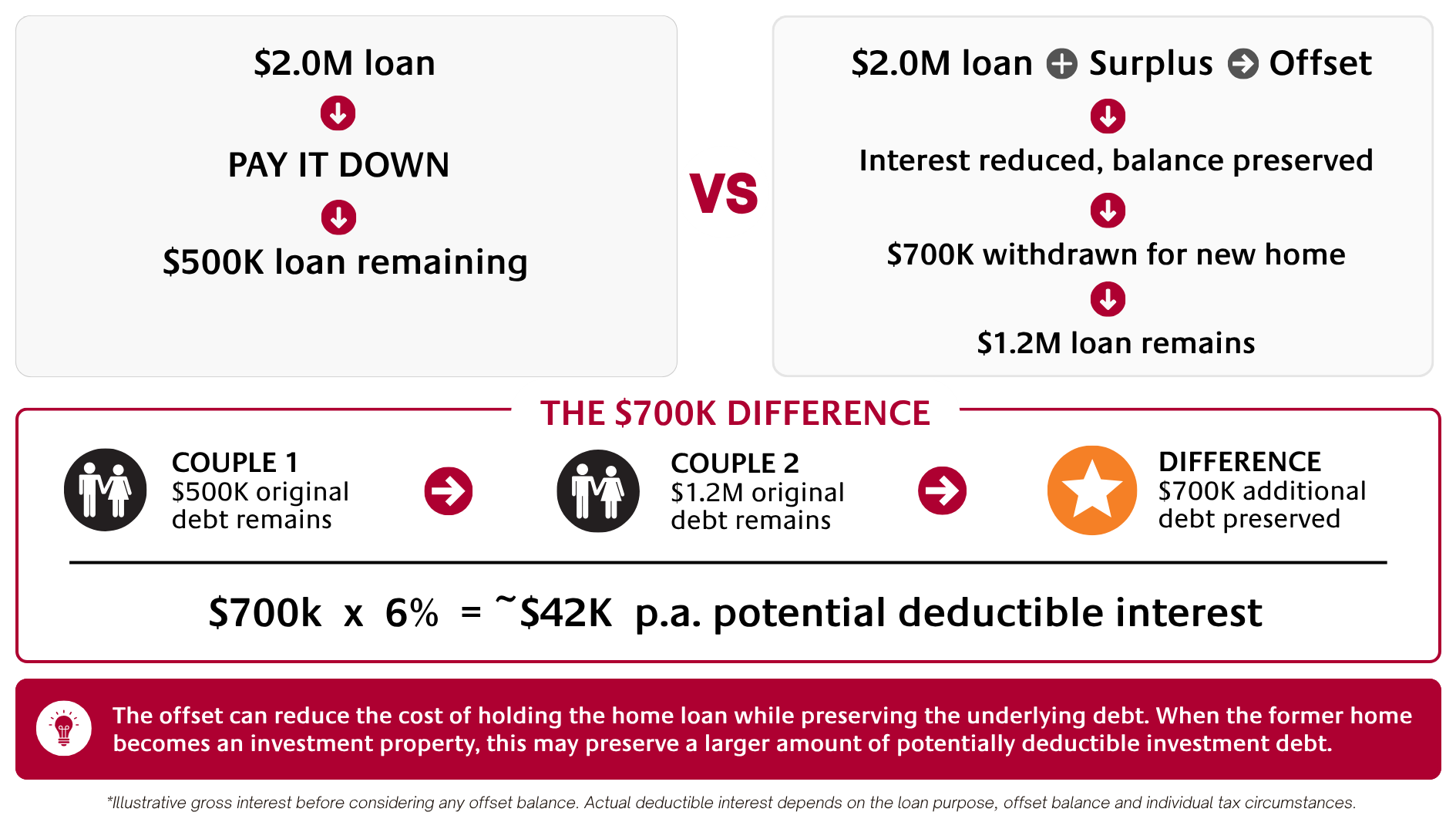
Couple 2 may therefore end up with an additional $700,000 of potentially deductible debt.
At an interest rate of 6%, that is approximately $42,000 per year in additional tax deductions. Yes, every year. Imagine the difference that could make over the 10 years leading up to retirement.
Both couples saved the same amount. Both paid roughly the same amount of interest while living in the home. The difference was simply where they kept their savings.
One couple kept the money in an offset account and preserved their options. The other permanently reduced the original loan and may not be able to recreate the same tax position later.
Why this matters now
Someone who buys an existing residential investment property after the Budget changes may no longer be able to claim its rental losses against their salary or other personal income.
On the other hand, someone who already owns a grandfathered property may retain that ability if they later turn the home into an investment property.
The Budget did not change how offset accounts work. It potentially made preserving the original debt against a property you already own much more valuable.
Some people prefer paying extra directly into the mortgage because it removes the temptation to spend the money. For many, that works well psychologically. But mathematically and strategically, paying directly into the loan can remove options that may become extremely valuable later.
If there is even a small chance that you may eventually upgrade homes and retain your current property, think carefully before making large additional repayments directly into the mortgage.
Get qualified advice before paying down the loan, using redraw or restructuring your debt. A decision that seems minor now could be worth tens of thousands of dollars per year in the future.
For more information, please contact Financial Adviser Rocky Johnston or your principal adviser.
 |
|
Associate Director, Financial Services
|